nmap scans
TCP connect scan filter:
tcp.flags.syn1 and tcp.flags.ack0 and tcp.window_size > 1024
Open TCP Port, Connect scan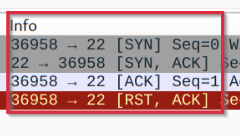
Closed TCP port, Connect Scan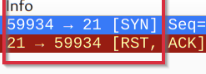
TCP SYN scan filter:
`tcp.flags.syn1 and tcp.flags.ack0 and tcp.window_size <= 1024`
Open TCP Port, SYN Scan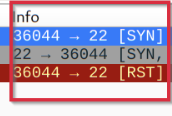
Closed TCP Port, SYN Scan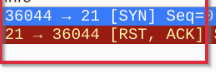
- Doesn't require a handshake process
- No prompt for open ports
- ICMP error message for close ports
UDP scan patterns filter:
icmp.type3 and icmp.code3
icmp.type 3→ Destination Unreachableicmp.code 3→ specifically Port Unreachable
For ICMP Type 3, some common codes are:
- Type 3, Code 0 → Network Unreachable
- Type 3, Code 1 → Host Unreachable
- Type 3, Code 2 → Protocol Unreachable
- Type 3, Code 3 → Port Unreachable
- Type 3, Code 4 → Fragmentation Needed

To see the ports, open the details for the packet
arp
legitimate
suspicious
DNS
signs of DNS trouble:
- Query length.
- Anomalous and non-regular names in DNS addresses.
- Long DNS addresses with encoded subdomain addresses.
- Known patterns like dnscat and dns2tcp.
- Statistical analysis like the anomalous volume of DNS requests for a particular target.
# filters:

dns contains "dnscat"
dns contains "dns2tcp"

dns.qry.name.len > 15 and !mdns

# !mdns -> Disable local link device queries.
ICMP
# find abnormal icmp packete sizes:
icmp and data.len > 64

# look for abnormal ICMP payload